
Are you tired of watching your phone desperately search for a signal while living in rural areas or during off-grid adventures? Dropped calls, failed texts, and glacial internet speeds can disrupt your work, safety, and connection to the world. You’re not alone. Fortunately, millions facing these frustrations daily have a proven solution: cell phone signal boosters.
In this ultimate guide, we’ll walk you through everything you need to know to select the perfect cell phone signal booster for rural and remote locations. More importantly, we provide specific, actionable steps to ensure you make the right investment for your unique situation, going beyond generic advice.
Why Cell Service Fails in Rural and Remote Areas
Before choosing any equipment, it’s crucial to understand why cellular signals struggle in these environments. Most urban-focused solutions fail because they don’t address these fundamental rural challenges:
- Distance from cell towers (the primary factor affecting signal strength)
- Terrain obstacles like hills, mountains, and valleys that block signal paths
- Dense foliage that absorbs and scatters radio frequencies
- Building materials in rural homes (metal roofs, concrete walls) that block signals
- Limited tower infrastructure with fewer towers covering larger areas
Understanding these challenges helps explain why your phone might show “No Service” even when you know there’s a tower within 20 miles.
How Do Cell Phone Signal Boosters Work in Rural Environments?
A cell phone signal booster is a system that captures, amplifies, and rebroadcasts existing cellular signals. Here’s how they work in challenging rural environments:
- Capture: An outdoor antenna (often mounted on your roof or a pole) captures the weak existing signal from distant cell towers
- Amplify: Coaxial cables carry this signal to an amplifier that boosts its strength (typically by 50-70 dB)
- Broadcast: An indoor antenna rebroadcasts the strengthened signal throughout your home, vehicle, or building
- Two-way communication: The system also strengthens your phone’s signal back to the cell tower, completing the communication loop
Ultimately, this process effectively extends the reach of distant cell towers directly to your location, providing reliable service where none existed before.
| Rural vs. Urban Signal Booster Needs | ||
|---|---|---|
| Feature | Rural / Off-Grid Needs | Urban / Suburban Needs |
| Signal Gain | High — 65–70+ dB | Moderate — 50–60 dB |
| Antenna Type | Directional (Yagi / LPDA) | Often Omnidirectional |
| Coverage Area | Oversized System (+30–50%) | Matched to Square Footage |
| Power Draw | Critical (12V / Solar option) | Standard (110V Wall Plug) |
| Key Challenge | Distance & Terrain | Building Penetration |
| Summary: Rural environments require higher-gain directional systems, while urban setups focus on indoor penetration and moderate coverage. | ||
Critical Pre-Purchase Steps: Don't Buy Until You Do This
Step 1: Measure Your Existing Signal Strength
The most important factor in booster selection is your outdoor signal strength. Follow these manual methods:
For iPhone Users:
- Dial 3001#12345# to access Field Test Mode
- Look for “RSRP” value (Reference Signal Received Power)
- -70 to -90 dBm = Strong signal | -91 to -110 dBm = Fair to Poor | -111 to -130 dBm = Very Weak | -131 dBm or worse = No Service
For Android Users:
- Download “Network Cell Info Lite” or “LTE Discovery”
- Check the RSRP or dBm value in the app
What your signal strength means for booster selection:
- -110 dBm or stronger: Most boosters will work well
- -111 to -130 dBm: You need a high-gain system with directional antenna
- -131 dBm or worse: You may be in a true dead zone where boosters can’t help
Step 2: Identify Your Carrier's Frequencies
Different carriers use different frequency bands. Use our Locate Nearest Cell Towers tool to identify which carriers and bands are available in your area. This is crucial because:
- Lower frequencies (600-900 MHz) travel farther but offer slower data
- Higher frequencies (1700-2100 MHz+) offer faster data but don’t travel as far
- Rural areas typically rely on lower frequency bands for basic coverage
Step 3: Calculate Your True Coverage Needs
Manufacturers’ coverage estimates assume ideal conditions. For rural areas, we recommend:
- Calculate your square footage (length × width for each floor)
- Add 30-50% buffer for rural signal challenges
- Consider future needs – it’s better to slightly oversize your system
Key Features to Evaluate for Rural and Off-Grid Use
Amplifier Power and Gain
Signal gain (measured in dB) determines how much the booster can amplify weak signals. You can also use our dBm Converter & Network Speed Estimator tool. For rural areas:
- Minimum 60 dB gain for moderate signal areas
- 65-70+ dB gain for very weak signals or larger spaces
- Higher uplink power is crucial for communicating back to distant towers
Antenna Systems: The Most Critical Component
The cell phone booster antenna for rural areas makes or breaks your system:
Outdoor Antenna Types:
- Directional (Yagi/LPDA) Antennas: These use a focused beam that reaches 2-3x farther than omnidirectional antennas, making them ideal for known tower locations.
- Omnidirectional Antennas: Offering 360° coverage, they are only suitable when towers surround your location (which is rare in rural areas).
- Panel Antennas: This style provides a balance of directionality and a wide coverage angle.
For 90% of rural applications, we strongly recommend directional antennas for their superior range.
Indoor Antenna Options:
- Panel antennas: Directional coverage for specific rooms
- Dome antennas: 360° coverage for central areas
- Multiple antennas: For covering large or multi-story spaces
Supported Carriers and Bands
Ensure your booster supports:
- All major carriers (Verizon, AT&T, T-Mobile, etc.)
- Current 4G LTE and Voice over LTE (VoLTE) bands
- 5G readiness for future compatibility
- Both low-band (long-range) and mid-band (faster data) frequencies
Best Off-Grid Cell Phone Booster Solutions
For true off-grid living, power consumption and portability become critical factors:
Portable Cell Signal Booster Options
For temporary locations, cabins, and RV use:
- WeBoost Drive Reach RV: Powerful enough for stationary use with vehicle power option
- SureCall Fusion2Go 3.0: Multi-user capability with strong amplification
- HiBoost Travel 3.0: Compact design with reasonable power draw
Power considerations for off-grid:
- Typical power requirements: 0.5-3 amps at 12V
- Solar compatibility: Many boosters work with standard 12V solar systems
- Battery options: Deep-cycle batteries can power most systems for days
Fixed Off-Grid Solutions
For permanent off-grid homes, consider:
- High-gain systems (65+ dB) to maximize limited signal
- Directional antennas on tall masts to clear terrain obstacles
- Low-power amplifiers that work with solar/battery systems
- Professional installation for optimal antenna placement
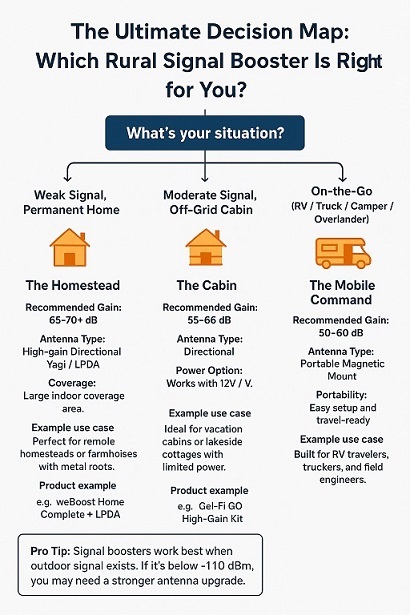
How to Choose a Cell Phone Signal Booster for Remote Locations: Decision Framework
Scenario 1: The Remote Homestead (Weak Signal, Large Coverage)
Scenario 2: The Off-Grid Cabin (Moderate Signal, Limited Power)
Scenario 3: Mobile Command (Vehicles, RVs, Remote Work)
Installation Tips for Maximum Rural Performance
Outdoor Antenna Placement
- Height is everything: Mount antennas as high as possible, clear of obstructions
- Direction matters: Point directional antennas precisely toward the cell tower
- Use our Antenna Placement Tool to find the optimal location and direction
- Lightning protection: Always use surge protectors for outdoor installations
System Configuration
- Maintain 20-50 feet separation between outdoor and indoor antennas
- Use high-quality, low-loss coaxial cable to preserve signal strength
- Avoid signal interference from other electronics and metal objects
Transform Your Rural Connectivity Today
Choosing the right cell phone signal booster requires careful consideration of your specific signal conditions, coverage needs, and power situation. By following this comprehensive guide, you’re now equipped to make an informed decision.
Remember, the combination of accurate signal measurement, proper equipment selection, and optimal installation separates successful installations from disappointing results. If in doubt, consult with signal professionals for personalized recommendations.
Don’t let poor signal isolate you any longer. With the right booster system, you can finally enjoy clear calls, fast data, and reliable connectivity—even in the most remote locations.