
What Is dBm? Understanding Cell Phone Signal Strength
If you’ve ever looked at the technical information on your phone and wondered what -85 dBm or -105 dBm actually means, you’re not alone. Most phones make cell signal look wonderfully simple: you have a few bars, so you assume everything is fine.
But those little bars don’t tell the whole story.
dBm gives you a much more precise way to understand how strong your cellular signal actually is. It can help explain why your phone works perfectly in one room but struggles in another, why two phones can show different numbers of bars, and whether your signal is strong enough for reliable calls and mobile data.
In this guide, we’ll look at what dBm means, why the numbers are negative, what counts as a good or bad cellular signal, and how you can use dBm to diagnose signal problems.
What Does dBm Mean?
dBm stands for decibels relative to one milliwatt.
It is a unit used to express power relative to 1 milliwatt (mW). In cellular networks, dBm is commonly used to describe the power level of the radio signal your phone receives from a cell tower.
In simpler terms:
dBm tells you how strong the cellular radio signal is at your phone.
The lower the dBm value, the weaker the received signal.
That last part can feel backwards at first.
You might naturally think that -100 is bigger than -70, so -100 should mean a stronger signal. But dBm doesn’t work that way. Because cellular signal measurements are usually below 1 milliwatt, the values are expressed as negative numbers.
So, for example:
-70 dBm is stronger than -100 dBm.
Think of it like this:
- -50 dBm → Very strong
- -60 dBm → Strong
- -70 dBm → Good
- -80 dBm → Good/Fair
- -90 dBm → Fair
- -100 dBm → Weak
- -110 dBm → Very weak
The exact point at which a signal becomes “good” or “poor” can vary depending on the network technology, carrier, phone, environment, and what you’re trying to do with the connection. So these ranges should be treated as useful guidelines rather than absolute rules.
Why Are dBm Values Negative?
This is probably the most confusing part when you first encounter cellular dBm.
A dBm measurement is referenced to 1 milliwatt.
If the measured power is exactly 1 mW, the value is:
0 dBm
Anything below 1 mW produces a negative dBm value.
For example:
- 1 mW = 0 dBm
- 0.1 mW = -10 dBm
- 0.01 mW = -20 dBm
Cellular signals received by a phone are normally much weaker than 1 mW. That’s why you commonly see numbers such as:
-65 dBm
-85 dBm
-105 dBm
and so on.
So don’t let the minus sign fool you. A value closer to zero represents a stronger signal.
Is -70 dBm Better Than -90 dBm?
Yes.
This is one of the most important things to remember about cellular signal measurements.
-70 dBm is stronger than -90 dBm.
And:
-90 dBm is stronger than -105 dBm.
You can picture the scale like this:
- -50 dBm
- -60 dBm
- -70 dBm
- -80 dBm
- -90 dBm
- -100 dBm
- -110 dBm
The difference isn’t merely cosmetic, either. Because dBm uses a logarithmic scale, a difference of 10 dB represents roughly a 10× difference in power.
That means -80 dBm isn’t simply “a little weaker” than -70 dBm.
What Is a Good dBm for Cell Phone Signal?
There isn’t one magic dBm number that guarantees a perfect connection.
Still, the following is a useful general guide for understanding cellular signal strength:
| Approx. dBm | General Signal Strength | What You Might Experience |
|---|---|---|
| -50 to -65 dBm | Excellent | Very strong reception |
| -65 to -75 dBm | Very good | Generally reliable calls and data |
| -75 to -85 dBm | Good | Usually reliable connection |
| -85 to -95 dBm | Fair | Performance may begin to decline |
| -95 to -105 dBm | Weak | Slow data or dropped calls may occur |
| -105 to -115 dBm | Very weak | Unreliable connection |
| Below -115 dBm | Extremely weak | Connection may be difficult or unavailable |
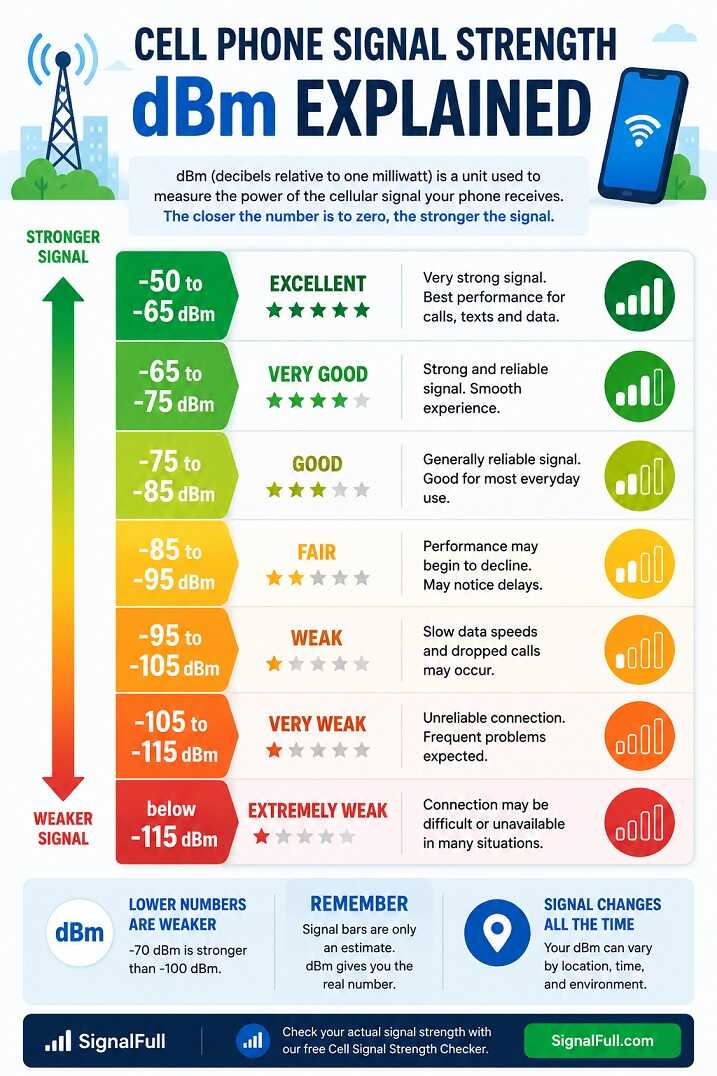
These are general guidelines, not universal thresholds.
A phone at -95 dBm can sometimes work perfectly well, while another situation at -85 dBm might perform poorly. Signal quality depends on much more than received power alone.
For LTE and 5G, measurements such as RSRP, RSRQ, and SINR can provide additional information about the quality of the connection.
We’ll get into those measurements separately.
What Does a Strong dBm Signal Look Like?
Let’s say you’re sitting at home and your phone reports:
-65 dBm
That’s generally a strong cellular signal.
You’d normally expect:
- Reliable voice calls
- Good mobile data performance
- Fewer connection problems
- Less trouble maintaining a connection indoors
Now imagine you move to the basement and the measurement changes to:
-100 dBm
You may notice:
- Slower mobile data
- Calls becoming less reliable
- Longer loading times
- Occasional dropped calls
- Difficulty connecting in certain areas
Move even farther away from the tower or behind more obstructions and you might see:
-110 dBm
At that point, maintaining a reliable connection can become much more difficult.
You can also use our free Mobile Signal Strength dBm Converter & Network Speed Estimator Tool to understand your mobile signals like a pro.
Why Does My dBm Keep Changing?
Don’t be surprised if your dBm number changes while you’re standing in the same room.
Cellular signal isn’t perfectly stable.
Your phone may move between different towers, bands, or network conditions. Buildings, walls, windows, trees, vehicles, and even your position inside a room can also affect the received signal.
For example, you might see:
-82 dBm
then:
-88 dBm
then:
-84 dBm
without actually going anywhere.
That’s normal.
The important thing is to look at the general signal level and pattern, rather than assuming that every small change means something is wrong.
Why Is My Signal Strong Outside but Weak Inside?
This is one of the most common cellular signal problems.
You might have:
-75 dBm outside
but:
-100 dBm inside
The reason is that the signal has to travel through the building before reaching your phone.
Materials such as:
- Concrete
- Metal
- Brick
- Low-emissivity glass
- Thick walls
- Insulation
- Underground structures
can weaken cellular signals.
Metal buildings can be particularly challenging because metal can block or reflect radio signals.
This is why someone can have a perfectly usable signal in their yard but almost no reception inside a building.
If you’re dealing with this problem, the solution isn’t necessarily “buy a booster immediately.” First, it’s worth measuring the signal and figuring out where the usable signal actually exists.
dBm vs Signal Bars
If your phone shows four or five bars, that’s useful—but it’s not a precise measurement.
The problem is that signal bars are a simplified representation of signal conditions.
Two phones might show different numbers of bars even when they’re receiving similar signal levels. Different manufacturers and network technologies can also calculate and display signal bars differently.
dBm gives you an actual numerical measurement.
For example:
Phone A: -72 dBm
is much more informative than:
Phone A: 4 bars
because the dBm number gives you something you can actually compare.
We’ll cover dBm vs signal bars in a separate guide.
How Can I Check My Cell Phone’s dBm?
Depending on your phone, carrier, and operating system, you may be able to find signal information through the phone’s built-in diagnostic or testing menus.
iPhone: Dial *3001#12345#* and press call (Field Test Mode).
Android: Settings → About Phone → Status → SIM Status.
However, the information available can vary considerably between devices.
An easier option is to use a dedicated signal-testing tool.
Check Your Cellular Signal
You can use the SignalFull Cell Signal Strength Checker to test your current signal and get a better understanding of your cellular reception.
Check Your Cell Signal Strength →
Once you know your signal level, you can use the dBm information to figure out whether you’re dealing with a strong, moderate, or weak connection.
What Is the Difference Between dBm and dB?
This is another common source of confusion.
Although dBm contains “dB,” they aren’t interchangeable.
dB
dB (decibel) is a relative measurement used to express a ratio or difference between two power levels or other quantities.
dBm
dBm is an absolute power measurement referenced to 1 milliwatt.
So:
dB describes a relationship or difference.
dBm describes power relative to 1 milliwatt.
You may encounter both terms when researching cellular networks, antennas, amplifiers, and signal boosters.
What Is the Difference Between dBm and dBi?
If you’re researching cell phone signal boosters, you’ll probably encounter dBi as well.
Don’t confuse it with dBm.
dBm
Describes signal power relative to 1 milliwatt.
dBi
Describes antenna gain relative to an ideal isotropic radiator.
In practical terms:
- dBm → How much signal power is being received or transmitted
- dBi → How an antenna’s gain is specified
This distinction becomes particularly important when you’re comparing cellular antennas and signal boosters.
We’ll cover dBi and the difference between dBm and dBi in more detail in our antenna guides.
Is a Higher dBm Always Better?
This is where the wording can get confusing.
With dBm, a number closer to zero generally means more received power.
So:
-70 dBm > -90 dBm
in terms of received signal power.
But a stronger signal does not automatically mean faster internet.
Why?
Because cellular performance also depends on factors such as:
- Network congestion
- Signal quality
- Interference
- Frequency band
- Tower capacity
- Network technology
- Distance from the serving cell
- Device capabilities
For example, you could have a relatively strong signal but still experience slow internet because the cell tower is congested.
That’s why measurements such as SINR and RSRQ can be useful alongside received signal strength.
dBm Isn’t the Whole Story
This is worth emphasizing.
If someone tells you:
“My phone is showing -85 dBm.”
that’s useful information—but it doesn’t tell us everything about their connection.
Two people could both have approximately -85 dBm and experience very different performance.
One might have:
- Clean signal
- Low interference
- Low network congestion
while the other might have:
- Significant interference
- Poor signal quality
- A congested cell
That’s why modern cellular diagnostics use several measurements.
You’ll commonly come across terms such as:
RSRP
A measurement commonly used to describe LTE/5G reference signal received power.
RSRQ
Provides information about signal quality and conditions affecting the received signal.
SINR
Describes the relationship between the useful signal and interference/noise and can be particularly useful when evaluating data performance.
These measurements are related, but they’re not interchangeable with dBm.
Can a Cell Phone Signal Booster Improve dBm?
Potentially, yes.
A properly installed cellular signal booster can improve the signal available to devices in an area by receiving an existing cellular signal through an outside antenna, amplifying it, and rebroadcasting it indoors.
But there’s an important catch:
A signal booster needs an existing usable signal to work with.
It isn’t a magic device that creates cellular service where absolutely none exists.
If you have a weak but usable signal outside your building and almost nothing inside, a properly installed booster may be able to help.
That’s why measuring signal strength outside and inside can be useful before deciding whether a booster is appropriate.
What dBm Should I Have Before Buying a Signal Booster?
There’s no single cutoff that applies to every installation.
Instead of asking:
“Is -95 dBm good enough for a booster?”
it’s better to ask:
“How strong is the signal where I can place the outside antenna?”
A booster works by capturing an existing cellular signal and improving coverage where you need it.
So if your indoor signal is poor but you can find a considerably stronger signal outside, that’s potentially a much more promising situation than having extremely weak or nonexistent signal everywhere.
Your outside antenna location, antenna type, cable losses, network band, building construction, and booster all matter.
How to Improve a Weak Cellular Signal
If your dBm reading is poor, don’t immediately assume you need expensive equipment.
Start by diagnosing the problem.
1. Check the Signal in Different Locations
Try:
- Near windows
- Upstairs
- Outdoors
- Different sides of the building
- Away from large metal objects
You may find that the signal changes dramatically from one location to another.
2. Check Different Times of Day
If signal strength is reasonable but your internet becomes slow at busy times, network congestion could be part of the problem.
3. Check Your Network Settings
Make sure your phone is connected to the network technology and bands available in your area.
4. Use Wi-Fi Calling When Appropriate
If cellular coverage inside your home is poor but your Wi-Fi connection is reliable, Wi-Fi calling can be a practical solution for voice calls.
5. Consider a Cellular Signal Booster
If the outside signal is usable but indoor coverage is poor, a properly installed booster may be worth considering.
Final Thoughts
So, what is dBm?
In the simplest terms, dBm is a way of expressing signal power relative to one milliwatt. When you’re looking at cellular signal strength, it gives you a much more useful number than simply counting the bars on your phone.
The most important thing to remember is:
With typical cellular dBm measurements, a number closer to zero means a stronger received signal.
So:
-70 dBm is stronger than -90 dBm.
And:
-90 dBm is stronger than -105 dBm.
But don’t judge your entire connection by dBm alone. Signal quality, interference, network congestion, frequency, and other factors can all affect how well your phone actually performs.
If you’re trying to troubleshoot weak reception, measure the signal first. Once you know the numbers, it’s much easier to understand what’s happening and decide what to do next.
Check Your Signal
Use the SignalFull Cell Signal Strength Checker to see your current cellular signal and start diagnosing your reception.
Check Your Cell Signal Strength →
Quick Summary
- dBm means decibels relative to one milliwatt.
- It is commonly used to describe cellular signal power.
- Cellular dBm readings are normally negative.
- -70 dBm is stronger than -90 dBm.
- A number closer to zero generally indicates a stronger received signal.
- Around -50 to -70 dBm is generally considered very strong.
- Around -100 dBm or lower generally indicates a weak signal.
- dBm doesn’t tell you everything about connection quality.
- RSRP, RSRQ, and SINR can provide additional information.
- Signal bars are convenient but aren’t as precise as numerical measurements.
- Measuring your signal before buying a booster can help you understand whether a booster is likely to help.