
Cell Phone Signal Strength dBm Chart: What Is a Good Signal?
If you’ve ever looked at your phone’s signal information and wondered whether -70 dBm is good, whether -90 dBm is too weak, or what on earth -110 dBm means, you’re not alone.
A cell phone’s signal strength can be represented by bars, but bars don’t tell you the actual number behind your connection. That’s where dBm comes in.
We have already discussed dBm vs Signal Bars. Now, this cell phone signal strength dBm chart will help you understand common dBm readings and what they generally mean in real-world situations. You’ll also learn why a higher-looking negative number actually represents a weaker signal, why your dBm can change as you move around, and why a strong signal doesn’t always mean fast internet.
Cell Phone Signal Strength dBm Chart
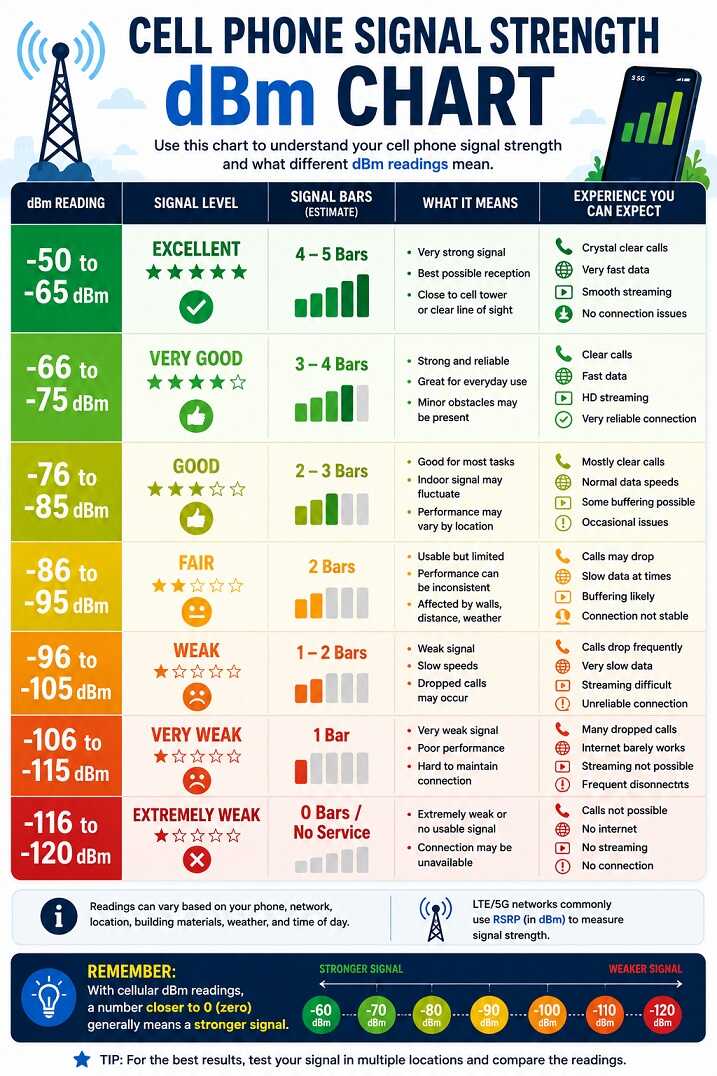
Here’s a practical reference chart for understanding common cellular signal readings:
| dBm Reading | General Signal Level | What It Usually Means |
|---|---|---|
| -50 to -65 dBm | Excellent | Very strong cellular reception |
| -66 to -75 dBm | Very Good | Strong and generally reliable connection |
| -76 to -85 dBm | Good | Good reception for most everyday use |
| -86 to -95 dBm | Fair | Usually usable, but performance may vary |
| -96 to -105 dBm | Weak | Slower data and occasional connection problems may occur |
| -106 to -115 dBm | Very Weak | Calls and data may become unreliable |
| -116 dBm or lower | Extremely Weak | Connection may be difficult or unavailable |
Important: this is a general guide, not a universal pass/fail scale. The meaning of a dBm reading depends on the measurement being reported, network technology, phone or modem, carrier, and local conditions. For LTE and 5G, RSRP is commonly used as a more specific measure of received cellular signal strength. Different equipment can use different thresholds. :contentReference[oaicite:1]{index=1}
How to Read a dBm Signal Strength Chart
The first thing to understand about a dBm chart is that the numbers are usually negative.
That makes dBm slightly confusing at first.
With typical cellular signal measurements:
The closer the number is to zero, the stronger the signal.
For example:
- -60 dBm is stronger than -70 dBm
- -70 dBm is stronger than -90 dBm
- -90 dBm is stronger than -100 dBm
- -100 dBm is stronger than -110 dBm
So if you see -75 dBm and your friend sees -95 dBm, your number is actually better, even though 95 looks like the larger number.
This is one of the most common things that confuses people when they first start checking their cell signal.
What Is a Good dBm Signal for a Cell Phone?
There isn’t one magic number that separates a “good” signal from a “bad” one.
In general, however, a reading around -70 to -85 dBm would usually indicate a strong or good received cellular signal, depending on the measurement and network technology.
Readings around -90 to -100 dBm are more marginal, while readings below about -105 dBm can become increasingly problematic.
For LTE, for example, some equipment documentation classifies RSRP above -90 dBm as excellent, -90 to -105 dBm as good, -106 to -115 dBm as fair, and below -115 dBm as poor. Other systems use somewhat different boundaries. :contentReference[oaicite:2]{index=2}
That’s why it’s better to use a dBm chart as a practical reference rather than assuming that one number guarantees a particular internet speed or call quality.
Is -60 dBm a Good Signal?
Yes. -60 dBm is generally a very strong cellular signal.
A reading around -60 dBm means your device is receiving a relatively strong signal. In a typical situation, you would expect reliable connectivity.
You might see readings around this level:
- Near a cell tower
- Outside a building
- Near a window with excellent coverage
- In areas with strong cellular infrastructure
Of course, strong signal strength doesn’t automatically guarantee the fastest possible data speeds. Network congestion and signal quality can still affect performance.
Is -70 dBm a Good Signal?
Yes. -70 dBm is generally considered a strong signal.
This is a very useful number to remember because it represents a healthy level of received signal strength in many cellular situations.
If your phone or cellular modem consistently reports around -70 dBm, weak signal strength itself is unlikely to be your main problem.
If you’re still experiencing slow internet or dropped calls, you may need to investigate other factors such as network congestion, interference, signal quality, or your device.
Is -80 dBm a Good Signal?
-80 dBm is generally a good cellular signal.
You should normally expect a usable and reasonably reliable connection at this level, although the exact experience depends on the network and the measurement being reported.
If you’re testing different locations in your home, finding a room with around -80 dBm compared with another room at -100 dBm can represent a meaningful improvement in received signal strength.
Is -90 dBm a Good Signal?
-90 dBm is usually considered a fair-to-good signal, depending on the technology and measurement.
At this level, your phone can still work perfectly well, especially when the network is not congested and the signal quality is good.
However, you may begin noticing differences compared with a stronger -70 or -80 dBm signal, particularly in difficult indoor environments.
For LTE RSRP specifically, -90 dBm is around the boundary that some equipment uses between excellent and good signal categories. :contentReference[oaicite:3]{index=3}
Is -100 dBm a Bad Signal?
-100 dBm is generally a weak or marginal cellular signal.
But “weak” doesn’t necessarily mean “no service.”
You may still be able to:
- Make phone calls
- Send text messages
- Browse the internet
- Use messaging apps
The problem is that the connection may be less reliable, particularly inside buildings or in areas with interference or network congestion.
If your signal is around -100 dBm indoors, it can be useful to check the reading outside the building. If the outdoor reading is much better, the building may be contributing significantly to the problem.
Is -110 dBm a Bad Signal?
-110 dBm is generally a very weak cellular signal.
At this level, maintaining a reliable connection can become difficult.
You may experience:
- Dropped calls
- Slow mobile data
- Long loading times
- Messages taking longer to send
- Frequent changes between network bands or technologies
- Loss of service in some locations
For LTE RSRP, some equipment classifies readings from approximately -106 to -115 dBm as fair and below -115 dBm as poor. Again, the exact thresholds aren’t universal. :contentReference[oaicite:4]{index=4}
Is -120 dBm a Usable Cell Signal?
-120 dBm is extremely weak.
At this level, you may have difficulty maintaining a reliable cellular connection.
Some devices may still connect, but performance can be poor and the connection may disappear entirely when conditions change.
If you’re consistently seeing readings around -120 dBm, especially where you need reliable service, it’s worth investigating your coverage and environment.
Why Does My dBm Keep Changing?
Don’t be surprised if you check your phone and see -82 dBm, then move a few feet and see -88 dBm.
Cellular signals are constantly changing.
Your dBm reading can be affected by:
- Your distance from the cell tower
- Walls and building materials
- Your position inside a building
- Windows and doors
- Terrain
- Trees and vegetation
- Interference
- Network conditions
- Which cell or frequency band your phone is using
Even small movements can sometimes change the way radio waves reach your phone because of reflections and obstructions.
This is why taking several measurements is usually more useful than relying on one reading.
Indoor vs Outdoor dBm: Why the Difference Matters
One of the easiest ways to investigate a weak indoor signal is to compare your dBm reading inside and outside.
For example:
| Location | dBm | General Interpretation |
|---|---|---|
| Outside | -72 dBm | Strong |
| Near window | -84 dBm | Good |
| Living room | -96 dBm | Fair/weak |
| Basement | -109 dBm | Very weak |
This pattern suggests that the building is reducing the signal as it travels indoors.
Concrete, metal, energy-efficient windows, and other construction materials can all contribute to indoor signal loss.
If you want to investigate this further, see our guide:
How to Boost Cell Phone Signal in a Metal Building
Why Your dBm Doesn’t Always Predict Internet Speed
This is extremely important.
dBm tells you about signal strength, but signal strength isn’t the same thing as internet speed.
Imagine two phones:
- Phone A: -75 dBm
- Phone B: -90 dBm
You might expect Phone A to have faster internet.
It could—but not necessarily.
Phone A could be connected to a congested cell, while Phone B might be connected to a less busy cell with more available capacity.
Other measurements can also matter. For LTE and 5G, metrics such as RSRP, RSRQ, and SINR provide different pieces of information about the connection. RSRP is primarily about received signal strength, while RSRQ and SINR help provide information about signal quality and interference. :contentReference[oaicite:5]{index=5}
So don’t assume that improving dBm alone will always improve your download speed.
dBm vs RSRP: Are They the Same Thing?
This is where cellular signal terminology can get confusing.
dBm is a unit of measurement.
RSRP is a specific cellular measurement that is expressed in dBm.
For example, you might see:
RSRP: -92 dBm
In this case:
- RSRP = what is being measured
- dBm = the unit used to express the measurement
Modern LTE and 5G equipment commonly uses RSRP when describing received cellular signal strength. Older or different systems may report RSSI instead. :contentReference[oaicite:6]{index=6}
This distinction is important because you shouldn’t automatically compare an RSSI reading with an RSRP reading as if they were exactly the same measurement.
Cell Signal Strength Chart: Quick Reference
If you don’t want to read the entire article every time you check your phone, here’s a simplified reference:
| dBm | General Level | Quick Interpretation |
|---|---|---|
| -50 dBm | Excellent | Extremely strong |
| -60 dBm | Excellent | Very strong |
| -70 dBm | Very Good | Strong signal |
| -80 dBm | Good | Good reception |
| -90 dBm | Fair/Good | Generally usable |
| -100 dBm | Weak | Marginal reception |
| -110 dBm | Very Weak | Unreliable reception possible |
| -120 dBm | Extremely Weak | Connection may be difficult |
Remember: these categories are general guidelines. Actual thresholds vary depending on whether the device is reporting RSSI, RSRP, or another measurement, as well as the network and equipment being used. :contentReference[oaicite:7]{index=7}
How to Find Your Cell Phone’s dBm Reading
Depending on your phone, you may be able to find detailed cellular signal information through a diagnostic or field-test menu.
The exact method varies between Android phones, iPhones, manufacturers, and operating system versions.
Some cellular routers and modems also provide detailed information such as:
- RSSI
- RSRP
- RSRQ
- SINR
If your device provides an RSRP value, that can be particularly useful when you’re evaluating LTE or 5G signal strength. :contentReference[oaicite:8]{index=8}
How to Test Your Signal Properly
If you’re trying to diagnose a reception problem, don’t just check your signal once.
Instead, take measurements in several locations.
For example:
- Check the signal in the room where you normally use your phone.
- Move near a window and check again.
- Try another room.
- Go outside and take another measurement.
- Compare the readings.
Suppose you get:
- -105 dBm in your bedroom
- -94 dBm in the living room
- -82 dBm near a window
- -73 dBm outside
That tells you much more than simply knowing that your phone has “one or two bars.”
It suggests that the signal is substantially stronger outside and that the building may be contributing to the indoor reception problem.
Can a Cell Phone Signal Booster Improve a Weak dBm Reading?
A cellular signal booster can potentially improve indoor reception when there is a usable cellular signal available to capture and redistribute.
A typical booster system uses an outside antenna to receive the cellular signal, sends that signal to an amplifier, and then distributes the improved signal inside the building.
However, a booster cannot create a cellular signal where there is no usable signal to begin with.
That’s why it’s a good idea to check the signal outside before purchasing a booster.
If you have a much stronger signal outside than inside, improving how that signal gets into the building may be a reasonable solution to investigate.
What Should You Do If Your dBm Is Very Weak?
If you’re consistently seeing readings below approximately -100 dBm, start by figuring out whether the problem is caused by your location, building, or network coverage.
Try these steps:
1. Move to a Different Location
Walk toward a window or move to another room. Even a small change in location can sometimes improve reception.
2. Test Outside
Compare your indoor reading with the signal outside. A significant difference can indicate that the building is blocking or weakening the signal.
3. Check Different Times
If your signal strength is reasonable but internet speeds become slow at busy times, network congestion may be part of the problem.
4. Check Your Network Information
If your phone or modem provides RSRP, RSRQ, or SINR information, look at those measurements as well rather than relying only on one number.
5. Consider a Signal Booster
If you have a usable outdoor signal but poor indoor coverage, a properly installed signal booster may be worth considering.
Frequently Asked Questions About dBm
What is a good dBm for a cell phone?
As a general guide, readings around -70 to -85 dBm are usually considered strong or good. However, the exact interpretation depends on the measurement type, network technology, device, and local conditions.
Is -70 dBm good?
Yes. -70 dBm generally represents a strong cellular signal.
Is -80 dBm good?
Yes. -80 dBm is generally a good cellular signal and should provide usable reception in many situations.
Is -90 dBm good?
-90 dBm is generally usable and can range from fair to good depending on the technology and measurement being used.
Is -100 dBm bad?
-100 dBm is generally considered weak or marginal. Your phone may still work normally, but you are more likely to experience performance or reliability problems.
Is -110 dBm bad?
-110 dBm is generally a very weak cellular signal. Maintaining a reliable connection can become difficult, particularly indoors or in challenging coverage areas.
Is -120 dBm usable?
-120 dBm is extremely weak. Some devices may maintain a connection at this level, but service can be unreliable or unavailable.
Is a higher dBm better?
With typical cellular dBm readings, a number closer to zero is stronger. Therefore, -70 dBm is better than -90 dBm, and -90 dBm is better than -110 dBm.
Does better dBm mean faster internet?
Not necessarily. Signal strength is only one factor affecting cellular performance. Network congestion, interference, signal quality, device capabilities, and available network capacity can also affect speed.
Final Thoughts
A cell phone signal strength dBm chart is a useful way to understand what the number on your phone or cellular modem actually means.
The basic rule is simple:
The closer the dBm number is to zero, the stronger the signal generally is.
So:
-70 dBm > -90 dBm > -110 dBm
But don’t get too hung up on one exact number. Cellular signal measurements vary, and a strong signal doesn’t automatically guarantee fast internet.
If you’re troubleshooting a weak connection, compare your readings in different locations and, when available, look at other cellular measurements such as RSRP, RSRQ, and SINR.
Once you understand your actual signal level, it becomes much easier to figure out whether the problem is your phone, your building, your location, or the cellular network itself.