
What Is dBi? Understanding Antenna Gain and dBm vs dBi
If you’ve been researching cell phone signal boosters, antennas, Wi-Fi equipment, or cellular signal strength, you’ve probably come across the term dBi.
At first glance, dBi can look very similar to dBm. Both use the familiar “dB” abbreviation, both appear in specifications for wireless equipment, and both can be found on antenna and signal booster product pages.
But they are not the same thing.
In simple terms, dBm tells you about power, while dBi tells you about antenna gain.
Understanding that difference is important when you’re choosing a cell phone booster, comparing antennas, or trying to figure out why one antenna may perform differently from another.
In this guide, we’ll explain what dBi means, how antenna gain works, what dBm means, and, most importantly the difference between dBi and dBm.
What Is dBi?
dBi stands for decibels relative to an isotropic radiator.
It is a measurement used to describe the gain of an antenna compared with an ideal theoretical antenna that radiates radio energy equally in every direction.
That theoretical antenna is called an isotropic radiator.
In practical terms, an antenna with a higher dBi rating is designed to concentrate radio energy more strongly in particular directions rather than spreading it equally in every direction.
For example, you might see antennas advertised as:
- 3 dBi
- 5 dBi
- 8 dBi
- 10 dBi
- 12 dBi
- 15 dBi
The dBi number gives you an indication of the antenna’s gain relative to the isotropic reference.
What Does dBi Mean in Simple Terms?
Here’s an easy way to think about it:
dBi describes how an antenna concentrates radio energy.
Imagine a flashlight.
A flashlight with a wide beam spreads its light over a large area. Another flashlight might have a narrower beam that concentrates the light farther in one direction.
An antenna can work somewhat similarly with radio energy.
A higher-gain directional antenna concentrates energy more strongly in particular directions.
However, this does not mean that a higher dBi antenna is automatically better for every situation.
Higher gain often comes with a change in the antenna’s radiation pattern. A highly directional antenna may work very well when it can be pointed toward the desired cell tower, while a lower-gain omnidirectional antenna may be more suitable when signals come from different directions.
What Is Antenna Gain?
Antenna gain describes how effectively an antenna concentrates or directs radio-frequency energy compared with a reference antenna.
For cellular and wireless systems, antenna gain is an important part of the overall radio link.
For example, the FCC’s broadband data specifications separately identify transmitter power in dBm and transmitting antenna gain in dBi. This illustrates an important point: power and antenna gain are separate parameters that work together in a radio system.
In a simplified system, you can think of the relationship like this:
Transmitter power + antenna gain − system losses = resulting radiated power
The exact calculation depends on the system and what quantity you’re calculating, but the basic idea is useful when comparing wireless equipment.
What Is dBm?
Before comparing dBi and dBm, it’s important to understand dBm itself.
dBm is a unit used to express power relative to 1 milliwatt.
In other words:
0 dBm = 1 milliwatt
dBm is commonly used to describe radio-frequency power levels and received signal levels.
For example, a cellular device might report a received signal level such as:
- -70 dBm
- -85 dBm
- -95 dBm
- -105 dBm
- -110 dBm
These numbers describe a power level, not antenna gain.
If you’re interested in understanding these numbers in more detail, see our guide:
What Is dBm? Understanding Cell Phone Signal Strength
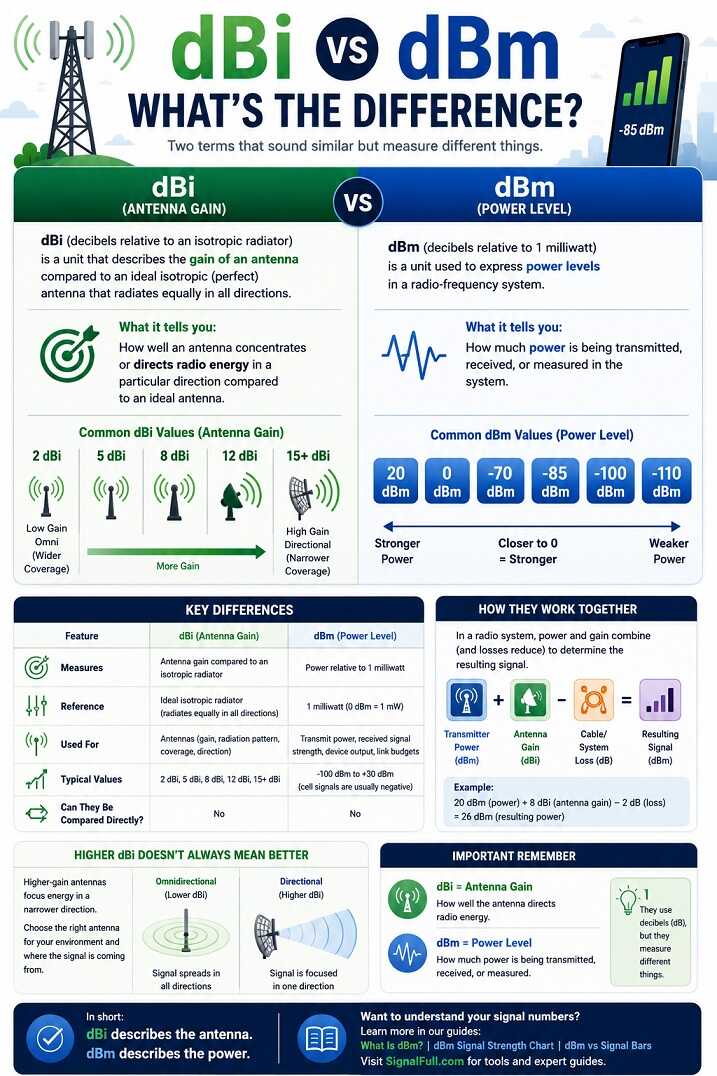
dBi vs dBm: What Is the Difference?
This is probably the most important part of the article.
| Feature | dBi | dBm |
|---|---|---|
| What it measures | Antenna gain | Power level |
| Reference | Ideal isotropic radiator | 1 milliwatt |
| Common use | Antennas | Transmit and received signal power |
| Typical examples | 3 dBi, 8 dBi, 12 dBi | -70 dBm, -90 dBm, 20 dBm |
| Can they be directly compared? | No | No |
The easiest way to remember the difference is:
dBi = antenna gain
dBm = power
They both use decibels, but they have different reference points and describe different characteristics of a wireless system.
Why Are dBi and dBm Both Used in Signal Boosters?
This is where things can become confusing when you’re shopping for a cell phone signal booster.
A signal booster system can contain several components, including:
- Outside or donor antenna
- Signal booster/amplifier
- Inside antenna
- Coaxial cables
- Connectors and other components
Each component can affect the overall radio link.
The antenna may have a gain rating expressed in dBi, while the booster or radio equipment may have power or signal levels expressed in dBm.
For example, imagine a simplified system with:
- 20 dBm transmitter power
- 8 dBi antenna gain
- 2 dB cable loss
A simplified calculation would be:
20 dBm + 8 dBi − 2 dB = 26 dBm
This is an example of how power, antenna gain, and losses can appear together in a radio link calculation. Real systems can be more complicated, and regulatory limits may also apply.
Does Higher dBi Mean a Stronger Signal?
Not necessarily.
This is one of the biggest misconceptions about antenna specifications.
A higher-gain antenna can concentrate energy more strongly in particular directions, but that doesn’t automatically mean it will provide better reception everywhere.
Consider two antennas:
- Antennna A: 3 dBi omnidirectional antenna
- Antennna B: 12 dBi directional antenna
The 12 dBi antenna has substantially more gain, but it may need to be aimed appropriately to take advantage of that gain.
The 3 dBi omnidirectional antenna may be a better choice in a situation where signals can arrive from multiple directions.
So when choosing an antenna, don’t simply look for the largest dBi number.
Consider the antenna type, radiation pattern, frequency range, installation location, and direction of the cellular tower as well.
What Is the Difference Between dBi and dB?
You may also wonder why manufacturers sometimes use dB instead of dBi.
They are related, but they’re not interchangeable.
dB is a relative logarithmic unit used to describe a ratio between two quantities.
dBi specifically describes antenna gain relative to an isotropic radiator.
For example, if a signal is amplified by 10 dB, you’re describing a gain ratio.
If an antenna is rated at 10 dBi, you’re describing its gain relative to the isotropic reference.
That’s why you shouldn’t simply assume that “10 dB” and “10 dBi” mean exactly the same thing.
What Is the Difference Between dBi and dBd?
Another antenna specification you may encounter is dBd.
dBd expresses antenna gain relative to a half-wave dipole antenna, while dBi uses an ideal isotropic radiator as the reference.
Because they use different reference antennas, the numerical values are different.
A commonly used approximation is:
0 dBd ≈ 2.15 dBi
Therefore:
dBi ≈ dBd + 2.15
This is another reason it’s important to check what reference a manufacturer is using when comparing antenna specifications.
How dBi Affects a Cell Phone Signal Booster
If you’re using a cell phone signal booster, the antenna’s gain can affect how effectively the system receives and distributes cellular signals.
For example, the outside antenna is often called the donor antenna. Its job is to communicate with the cellular network.
The inside antenna then distributes the boosted signal within the building.
Depending on the antenna type and installation, antenna gain can influence how the system performs.
However, antenna gain is only one part of the equation.
The overall result can also depend on:
- Outdoor signal strength
- Distance from the cell tower
- Frequency band
- Antenna placement
- Antenna direction
- Coaxial cable length
- Cable losses
- Building materials
- Interference
- Booster amplifier performance
This is why simply buying the antenna with the highest dBi rating isn’t necessarily the best way to improve cellular reception.
Does a Higher dBi Antenna Increase Cell Phone Signal?
It can improve the effective signal in the direction where the antenna provides its gain, but the result depends heavily on the installation and the antenna’s radiation pattern.
For example, a directional antenna with higher gain can be useful when you know where the serving cell tower is located and can aim the antenna appropriately.
An omnidirectional antenna, on the other hand, can be useful when coverage is needed around the antenna or when the desired signal may come from different directions.
The goal isn’t simply to find the highest dBi antenna.
The goal is to find the right antenna for the particular environment.
Can You Convert dBm to dBi?
No, not directly.
dBm and dBi describe different things.
dBm describes power relative to 1 milliwatt, while dBi describes antenna gain relative to an isotropic reference.
Therefore, asking to convert -90 dBm into dBi is a little like asking how many miles are in five kilograms. The two measurements don’t represent the same physical quantity.
However, dBm and dBi can appear together in a radio link or antenna calculation.
For example, transmitter power can be expressed in dBm, antenna gain in dBi, and cable loss in dB.
Those values can then be combined as part of a link-budget calculation.
How dBm, dBi and dB Work Together
Here’s a simple example.
Imagine a wireless transmitter producing:
20 dBm
It is connected to an antenna with:
8 dBi gain
There is also:
2 dB of cable loss
The simplified result is:
20 dBm + 8 dBi − 2 dB = 26 dBm
The important lesson isn’t the particular number in this example. It’s the role each measurement plays:
- dBm: power
- dBi: antenna gain
- dB: relative gain or loss
Real-world radio systems can involve additional factors, including propagation loss, connector losses, receiver sensitivity, interference, and regulatory limits.
Why Antenna Gain Is Important in a Link Budget
A link budget is essentially an accounting exercise for a radio connection.
It considers the power going into the system, gains that improve the link, and losses that reduce it.
A simplified link might look something like this:
Transmitter power → cable losses → antenna gain → propagation losses → receiving antenna gain → receiver
The FCC’s broadband documentation uses the same general concept, listing transmitter power, antenna gain, path losses, receiving antenna gain, and received signal strength as separate parameters.
This is why understanding dBi becomes particularly useful when you’re dealing with antennas rather than simply looking at the signal bars on a phone.
What Does 8 dBi Mean?
An antenna rated at 8 dBi has a gain of 8 decibels relative to an ideal isotropic radiator.
It doesn’t mean that the antenna produces 8 dBm of power.
It also doesn’t mean that your phone will automatically receive a signal that is 8 dBm stronger.
The actual improvement at the receiver depends on the complete radio system and how the antenna is installed and oriented.
What Does 12 dBi Mean?
A 12 dBi antenna has higher gain than an 8 dBi antenna when both are evaluated using the same reference.
But higher gain generally means a more concentrated radiation pattern.
That can be helpful in some applications and less useful in others.
For example, a high-gain directional antenna can be valuable when communicating over a long distance toward a known direction.
For a cellular signal booster, antenna selection should therefore be based on the actual installation rather than the dBi number alone.
Does dBi Affect Signal Strength on Your Phone?
It can indirectly affect the signal available to the phone because antenna characteristics influence how radio energy is transmitted or received.
However, your phone’s reported signal measurement (such as an RSRP value on an LTE or 5G connection) is a different measurement from antenna gain.
For example:
Antenna: 8 dBi
Phone signal: -85 dBm
These numbers should not be added together or compared as though they were measuring the same thing.
The antenna’s gain is one factor in the radio system that can influence the resulting received signal level.
Frequently Asked Questions About dBi and dBm
What does dBi stand for?
dBi stands for decibels relative to an isotropic radiator. It is commonly used to express antenna gain.
What does dBm stand for?
dBm stands for decibels relative to one milliwatt. It is used to express power relative to a 1 mW reference.
Is dBi the same as dBm?
No. dBi measures antenna gain, while dBm measures power. They have different reference points and should not be treated as interchangeable measurements.
Is higher dBi better?
Not always. A higher-gain antenna may concentrate radio energy more strongly in a particular direction. Whether that is beneficial depends on the antenna type, installation, and application.
Can I convert dBm to dBi?
No, not directly. dBm measures power and dBi measures antenna gain. They are different quantities.
Does higher dBi mean more power?
No. dBi describes antenna gain, not the amount of electrical power supplied to the antenna.
What is a good dBi for a cell phone antenna?
There isn’t one universally “good” dBi value. The appropriate antenna gain depends on whether the antenna is omnidirectional or directional, the installation environment, the frequency bands being used, and the location of the cellular tower.
What is the difference between dBi and dB?
dB is a general logarithmic way of expressing a ratio or gain/loss, while dBi specifically describes antenna gain relative to an ideal isotropic radiator.
What is the difference between dBi and dBd?
dBd expresses antenna gain relative to a half-wave dipole, while dBi uses an isotropic radiator as its reference. A commonly used relationship is approximately 2.15 dB between the two reference points.
Final Thoughts
If you remember only one thing from this article, remember this:
dBm and dBi are not the same measurement.
dBm tells you about power.
dBi tells you about antenna gain.
When you’re looking at a cell phone signal booster or antenna specification, dBi helps you understand the antenna’s gain, while dBm can describe the power level or received signal level within the radio system.
Neither number should be viewed in isolation.
A high-gain antenna isn’t automatically better, just as a particular dBm reading doesn’t tell you everything about the quality or speed of a cellular connection.
Once you understand the difference between these measurements, antenna and signal booster specifications become much easier to understand.
If you’re also trying to understand the actual signal reading on your phone, continue with our guide to what dBm means for cell phone signal strength.
Quick Reference: dBi vs dBm
| Term | Meaning | Used For |
|---|---|---|
| dBi | Decibels relative to an isotropic radiator | Antenna gain |
| dBm | Decibels relative to 1 milliwatt | Power and signal levels |
| dB | Logarithmic ratio | Gain, loss, and differences |
| dBd | Decibels relative to a dipole | Antenna gain |